
First published in the Summer 2021 isssue of The Exponent II.
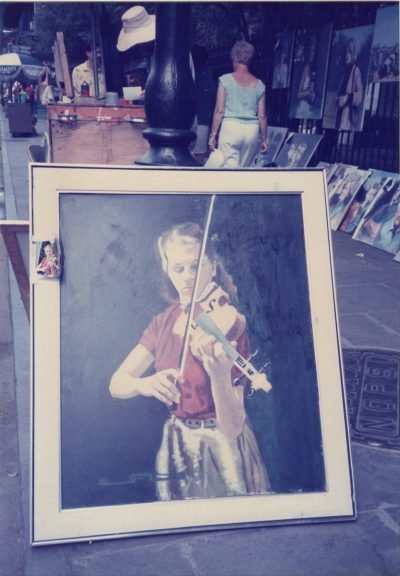
There used to be a painting of me on display in Jackson Square in front of the St. Louis Cathedral in New Orleans. The artist named it “The Belle of the French Quarter.” I suppose I should have been honored, but in truth, at the time I didn’t like it. The sunlight on my face is too bright; it cast stark shadows, making me look commonplace. I’m wearing one of my more casual outfits: khaki shorts and a red polo shirt, nothing special. The angle of my violin is not well placed on the canvas, and the bow cuts across my face at an odd angle. But to the artist’s credit, that is precisely the way I look in the snapshot. It was a hot sunny day and he painted me exactly as he saw me.
I was 18 years old when I crawled out of my bedroom window in Berkeley and drove off in the middle of the night with a friend, my violin stowed away in the trunk. At the time, I wasn’t on the best of terms with my mother. I thought she was too controlling and trying to live vicariously through me. I had already postponed college for one semester, but I felt I needed more time to figure myself out. I was confused, terrified even, but I didn’t know how to put words to my feelings. So rather than face my mother, I allowed a friend to convince me to up and leave.
We were nomads that first year, traveling by car north to Seattle, where we stayed with some friends and then took off across the country to Bloomington, Indiana. We got ourselves an apartment and worked at odd jobs. I hadn’t left my family a note when we left, so about six weeks into our travels, I called my sister and told her I was okay.
We returned to Seattle briefly after a few months, but no longer felt we belonged. Tempting fate, we set out to cross the country again during a major winter storm. When the snow started falling as we were passing through southern Wyoming, I wasn’t too concerned. I had driven through storms before and had been okay. But this evening the winds picked up and the falling snow was joined by a bank of fog which obscured my vision. The reflection from the headlights blinded me. I inched along, pressing lightly on the gas pedal, praying that we wouldn’t get hit from behind. Periodically, I opened the car door and peered down at the road, hoping to see that blessed dotted line to use as a guide. I caught sight of it intermittently between patches of packed ice and snow, and it gave me confidence to keep going. I finally made it to the next exit and had just barely pulled over to the side of the road when our car’s engine stopped and wouldn’t start up again.
We were saved by a kind man with a tow truck whom I had managed to call from a convenience store a couple blocks away. He took us to his shop and let us stay there all night. I will never forget how impressed I was that even though we were complete strangers, he trusted us enough to let us rest and thaw out in his shop, sheltered from the raging storm outside. It wouldn’t be the last time I felt touched by the kindness of a stranger on this journey. The next morning we drove off under clear skies, grateful to be alive.
We drove to Virginia, then north, stopping briefly in Philadelphia, New York City, and Boston, and then headed west to Chicago. It was when we got to Minnesota that we finally decided to head south.
I mostly remember being hungry and cold during our travels, so arriving in New Orleans in the early spring of 1985 was amazing. In the French Quarter I could pull out my violin for a couple of hours and make enough money to buy food and a motel room for the night. The violin had always been special to me. I called it “my baby,” and playing it tethered me to my past while on the road. I’d started studying music at age four and received my first violin for my fifth birthday. I’ll never forget that day, opening the oblong case next to my mother, my heart pounding at the sight of the shiny wooden box with its long tight strings, my fingers tracing the curved lines of its spiral scroll.
New Orleans was a land of opportunity, and the locals took good care of me. There was a sweet couple — regulars — who would greet me every evening with a smile and leave two dollars in my case. The bartender at La Touché poured me a blend of orange and cranberry juice, and introduced me to the other customers, mostly locals, who would share anecdotes about life in the French Quarter. The maitre d’ at the Rib Room at the Royal Orleans Hotel would invite me inside to play for special guests. When a dentist who lived in the Garden District discovered that my friend and I were staying in a motel, he invited both of us to stay with him and his family until we found an apartment. A street artist asked if he could take a few snapshots of me and use one of them to create a painting; if it sold, he offered to give me a commission.
There were a few hours during the day when Royal Street was closed off to motor vehicles, and I could set up in the middle of the street. One afternoon, a large crowd gathered around me. I was playing a fast, showy piece, and at the end everyone burst into applause and opened up their wallets. The dollar bills piled up so high that they were overflowing from my case onto the street. A young man came up to me with a big smile and said that he was blown away by my playing. He had just arrived in town and was completely broke, but said that if he could, he would totally leave me some money.
“Don’t worry about it,” I told him. “I was broke when I got here too. If you want some cash, help yourself.”
“You can’t be serious,” he said.
“No really. I’ve got more than I need. Take some, leave some; it’s all fine.”
A year later he paid me back — with interest and the same charming smile.
Some of the best tippers were sports fans from out of town — happy, exuberant and hopeful before the game — cocky, loud and boisterous afterward. When New Orleans hosted the Superbowl in 1986, we street performers made a killing. People really loosen up with their bigger bills when they are celebrating. Mardi Gras was a lucrative time, too, but I had to pack up before things got too out of control. I didn’t want my violin getting drenched in beer or crushed in the melee.
It’s strange to say this now, but I really did feel protected in New Orleans. I felt like everyone had my back. There were nights when I would purposefully walk down a dark alley just to prove to myself that I could and that no harm would come to me. Somebody once asked me, “Do you have any idea how famous you are? Everyone in this city knows you.” Truly, not only did I feel known, I felt beloved. I had never felt so connected to such a vast array of people. Rich and poor. Black and white. Cab drivers, restaurant waiters, even bouncers and Bourbon Street dancers. After two years of playing classical violin on Royal Street, I had become a fixture, an adopted icon, an anomaly in the jazz-centric Mecca.
But over time, the life of a street musician is emotionally draining, and the money isn’t always good. I remember commiserating with a fellow street performer — a clown — whose name I can’t recall. He had bad teeth, a gregarious laugh, and a hat with a sign that read “Tipping is not just a city in China.”
I once asked him how he was making it through the day.
He scoffed and said, “The town is full of nuns.” He blew up a balloon and twisted it into a poodle. He tried giving it to a passing tourist but was ignored. He put the unwanted animal into my case and blew me a kiss as he walked away.
I did get a few indoor jobs, which were particularly welcome during the winter months as cold weather was a harbinger of lean times. I gave private violin lessons to the young daughters of a neighbor. The Hyatt hired me for a few weekends to play in their revolving restaurant, the Top of the Dome, and the Esplanade Mall across the Mississippi River invited me to serenade tables in their dining area. I even joined the local Musician’s Union and was invited to sub with the New Orleans Symphony for a season.
But those jobs were few and far between, so when bills were due or food was scarce, I’d hop onto the street car, rain or shine, and head to the French Quarter. I would tough it out as long as possible, but more often than not when the weather was bad, I’d return to my apartment with just a few extra bucks, barely enough to cover the cab ride home. During Hurricane Juan I no longer had a car, so I didn’t have the luxury to leave town. I hunkered down with my roommates, put tape up on the windows, and hoped for the best. Thank goodness I wasn’t there for Katrina. After living on the edge for two years in New Orleans, I longed for safety and stability.
I was also, to my surprise, becoming terribly homesick. One Thanksgiving a friend invited me to dinner. His mother showered me with a love that shocked me. It was as though a bolt of lightning had penetrated my tough exterior, illuminating some deep longing that had remained dormant — I missed my family. While I had been supported daily by the kindness of others, the seemingly carefree life of a nomad was wearing on me. I realized that there are things far worse than having a parent who wants her child to succeed. After three years, I was determined to make amends and repair my relationship with my mother.
My parents visited me once in New Orleans, and I took them on a tour of the French Quarter. We walked along Royal Street and browsed the antique shops and art galleries. I pointed out the corner where I played most of the time and we stopped to listen to a band. We had lunch at The Court of Two Sisters where I introduced them to a friend who worked there. Later that afternoon we walked to Jackson Square, and I showed them the portrait that the artist had painted of me. My father took a picture of it from a distance so you can see in the background the artist at his stand along with numerous other paintings and sketches leaning up against a fence. In that setting it suddenly all made sense. Artistically the painting might be imperfect, but it belonged there. It had a place, a purpose, and a creator.
When I step back and look at that time of my life, I use broad gestural strokes to capture the essence of my journey: I took an extended gap year, I went on a road trip with a friend, and I made a place for myself in New Orleans. There must be hundreds, if not thousands, of snapshots of me in photo albums throughout the world taken by tourists who wanted to capture a moment in time. I imagine many of them are flawed — possibly blurry or poorly lit. Indeed, I have no say over how those pictures turned out or how others perceived me. But what I can say is that in those moments I belonged there. I had made a place for myself in that city and, in spite of all of my imperfections, I had a purpose: I played my songs, I made some friends, I left my mark. And then, when I was ready, I took a step back, signed my portrait, and said farewell.
Cybele,
I had no idea that you were in New Orleans while I was there, from ’94-98. It IS indeed, a special place. I’m glad it helped you find yourself. So glad we connected in Berkeley and at the Oakland welding school.
Thank you Nancy! I was actually in New Orleans from 1985-87. It was soon after I returned that I started working with you at Airco. I have good memories of our early morning commutes together. What ever happenened to that school? I hope you’re doing well!
Cybele,
Wonderfully written. I remember those three years. So good to read your words about those years. What an experience. Sure love you.
Nancy VS
Thank you, cousin! I do believe that the protection I felt during those years was due in large part to all of the prayers sent heavenwards daily by you and other family members and friends. Love you too!
I love this so much, Cybèle! What an incredible experience. And how beautiful that you found community & connection along the way.
Thank you, Amber! Life as a street musician certainly had its challenges, but you’re right – the bond that I formed with the people and the community was really special.
Great story Cybele!
Thank you, Kim!
Love how you portray your adventures… sending hugs
Thank you for reading my stories, Ondine! Hugs back at you 🙂