
I wrote a short story about 10 years ago that I really want to publish. It’s a fun, whimsical story told in poetic form about the joys and power of music and music-making. I envision it as a picture book for children ages 5-8 years old, but while the words to the story have for the most part made it onto the page, the illustrations have not.
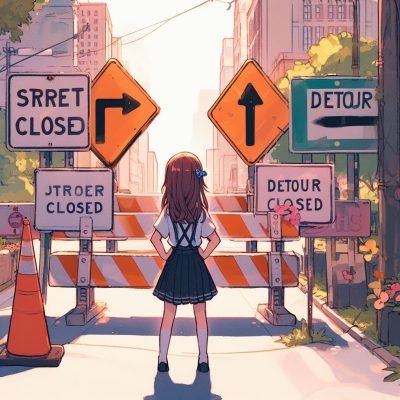
But that’s just one of my roadblocks. In fact, when it comes to making progress on this project, obstacles are the one thing that are not in short supply. I confess that most of these barriers dwell in my head. They take turns waving their arms about like a traffic cop ordering me to turn around and go back in the other direction. They say things like: “Does the world really need another picture book? There are far better writers than you. You’re wasting your time.” When I try to silence these voices and take another route, out pops another officer, another voice in my head, flags waving, whistles blowing, as if to say, “This way is blocked! Turn around! Don’t come back!”
I wonder sometimes if finding myself in this predicament is just a test of sorts to prove that I am worthy of the story I have written. It’s a good story - not perfect, certainly - but it has potential. I know I’ll need a copy editor, an illustrator (of course) and a lot of other smart people to pull it off, but I wonder if the most crucial thing that has to happen is for me to fully embrace the message of this story. In order for my story to truly come to life, I need to believe in it. I need to live it. But that is far easier said than done - hence, another roadblock.
The story is about a young girl who is confined at home for reasons that are not readily apparent. She may have a chronic illness or she may be living in a war zone. She might be overwhelmed by grief or even enslaved by her own fears and insecurities. Regardless, the protagonist longs to visit the places she can see from the windows of her home. The opening lines of the story encapsulate her spirit of adventure: “Take your music for a ride, Let it be your travel guide, Tune your strings, spread your wings, Up bow, down bow, up bow, down.”
I envision the girl in the story surrounded by paintings and maps and artwork - images of beautiful and inspiring places. When she picks up her violin and draws the bow across the strings her music transports her to these far away places. In her mind she travels up towering mountains and through majestic forests. She is mesmerized by the crashing of ocean waves upon the shore and stops to admire a fragrant blooming bush of roses. She walks along bustling streets, visits awe-inspiring landmarks and observes the lengthening shadows of skyscrapers as the setting sun lights up the sky with a symphony of colors. All of this happens while she plays her violin alone in her practice room.
It probably wouldn’t come as a surprise that in many ways I see myself as the girl in the story. I began my musical studies when I was four years old and over the course of my life, I have performed my violin throughout the world in a vast array of conventional and non-conventional venues: in concert halls, churches, forest groves, shopping malls, on sidewalks and in limousines. I have played for weddings, anniversaries and bachelor parties. I have performed at dance festivals, in pubs and even once at Davies Symphony Hall in San Francisco for the Queen of England. In every setting, no matter where I was, music has had the power to both transport and transform me. When I returned home to my practice room, I would take out my violin, draw the bow across the strings and be transported back to all the many places I had been.
Like the room in my story, my practice room at home growing up had a large floor to ceiling window which looked out onto the San Francisco Bay. The room had a high vaulted ceiling and was filled with antique furniture, a grand piano, oriental rugs and beautiful paintings. The acoustics were marvelous and I knew at the time how privileged I was to be able to spend so many hours in this room.
Several decades later, as an adult and with a family of my own, I returned to live in that home again. My mother had passed away unexpectedly so I took over her role as caregiver for my father who had dementia, bipolar disorder and Parkinson’s disease. While there for over ten years, I transformed that remarkable room where I had learned to play the violin into a teaching studio of my own where I taught violin, viola, piano and chamber music. I hosted countless workshops, rehearsals and recitals. The room was alive with the constant sounds of music.
That room also served as a portal to another dimension where I felt my mother's presence and her approval. It was because of her love of the performing arts that I even learned to play the violin. She was the one who took me to all of my lessons and orchestra rehearsals as a youth and who made sure that I practiced every day. She was the one who made sure I had all the right equipment and supplies including a good instrument, extra strings, a metronome and plenty of sheet music. She was the one who embraced me after a bad lesson or a failed audition and persuaded me to keep at it.
So being in that room during those years after her death, teaching in that room, doing something that I knew she would have loved to see me do, comforted me. I felt her close to me and in addition to providing me with encouragement to continue the often exhausting work of caring for my father, it made the music I worked on with my students even more special and meaningful.
It was several years after her death that I wrote my story. I am not altogether sure what prompted it, but I did have a young son who was born with a serious health condition. He ended up having to spend much of his time in the hospital and at home. Part of me hoped that I could spin my mother’s magic and inspire my son to play the violin. I believed or wanted to believe that music could open up the world to him in the same way it had for me. But to my disappointment, he had no interest in learning to play the violin or any other instrument for that matter. He had other diversions, other passions, other ways that helped him cope with his feelings of isolation. He was finding his own path and I felt I had to respect his choices and support him on his own journey even if it didn’t align with what I had envisioned for him.
However, when it came to how I felt about my story, his reluctance did become another roadblock. There it was again - another negative voice in my head telling me that I had no business writing a book for children about music when I clearly was unable to pass that message along to my own child. I felt like a failure.
Then Covid19 made its appearance and although I wrote my story long before the pandemic, it became apparent to me that the experience of living through a global health crisis with its subsequent lockdowns and quarantines should have been a testing ground for my story’s premise. I should have been able to put my hypothesis to the test. I should have been able to prove that playing music could sustain me even when my connections with the outside world had been severed. But it failed. It didn’t work. Music did not sustain me. I felt more disconnected than ever from my instrument.
Moreover, due to fears of the spreading virus, I suspended teaching in-person lessons. I transitioned some of my students to online, but a large majority of them chose to quit. My thriving teaching studio collapsed. At first I took it in stride. I took a deep breath - many deep breaths actually - and like so many other people at the start of the pandemic, I turned to such things as meditation and writing and gardening to soothe my soul.
Then a year into the pandemic my father died and we had to move. Bidding farewell to the home I grew up in and no longer being able to play or teach in that marvelous room became the biggest roadblock yet in getting my story published. I felt an inextricable bond to that space. I questioned how my story could even exist if I no longer had access to that room. Finding myself on the outside looking in challenged my understanding of the core message of my story. I had no choice but to view it from a completely different perspective.
I now live in a neighborhood with a lot of barricades. A heavily-trafficked thoroughfare connecting two major highways runs near my house. The purpose of the barricades is to keep the flow of traffic moving as expeditiously as possible through this corridor and it significantly limits the amount of traffic through our residential neighborhood. I can no longer view the bay from the windows of my house, but I do enjoy going on walks and looking at all the well tended gardens in my quiet neighborhood.
My story, like the busy arterial roadway near my home, may end up being a conduit of a broader message: everyone experiences loneliness and everyone craves connection. Music worked for me in the past as that conduit and maybe it will again, but I now believe that not all roads are blocked to keep me from reaching my goals. The connection I most crave is the one with myself. The test I most urgently need to pass is the ability to recognize that my need to change and adapt is not just part of my journey but an integral feature.
The story I wrote remains true and relevant, despite the changes in my circumstances. Nevertheless, I also need to be willing to let it go. If it’s meant to come into the light, it will happen. In the meantime, I will take a page from my story and explore the sounds of the city, gaze out at the setting sun, and stop and smell the roses along the way.
Friends, I’m determined to find a way forward. As I navigate my way through these challenges, I’d love to hear how you all have overcome obstacles in your lives.
Image credit: created by Bing, Microsoft’s AI program, when I inserted the following prompt: “a detour sign and a street closed sign on a barricade. A girl holding a violin standing facing the barricade is unsure which way to go.” Interesting, of the four images it created, I picked the only one that didn’t have a violin.
0 Comments